

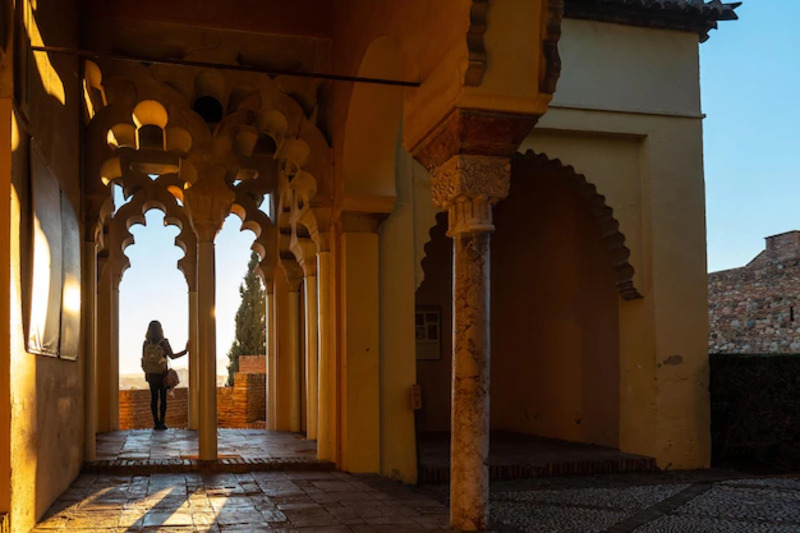
The Alcazaba of Malaga
Are you in Málaga and not sure what to see (link to ‘What to see in Málaga’)? If you’re visiting this city on the Costa del Sol, a must-see is the Alcazaba in Málaga, one of the most impregnable fortresses of the Middle Ages.
We are talking about a building constructed during the period when the Muslims occupied the peninsula, Al-Andalus. It is said that the Taifa king of Málaga, from the Hamudid dynasty, was responsible for its construction; subsequently, some sources mention that Badis Habus, king of the Zirid dynasty of Granada, oversaw its renovation and extension.
The Alcazaba in Málaga stands at the foot of Gibralfaro Hill, and right at its base lies the Roman theatre, which served as a cemetery whilst the Alcazaba was being built, and from which some stones were taken to construct it. Right opposite, in fact, stands the Palacio de la Aduana, a fine example of Renaissance architecture. All this makes the area a unique blend of cultures – Arab, Roman and Renaissance – transforming this corner into an unrivalled intercultural gem that you simply mustn’t miss.
A visit to the Alcazaba in Málaga is the perfect way to round off a night out enjoying tapas at that fantastic restaurant PEZWANDA, just 10 minutes from the Alcazaba, you’ll get to try the best tapas in Málaga, prepared by the great Diego René.
Below, we’ve put together a tour of the interior of the citadel so you don’t miss a thing, along with the opening times and ticket prices.
What is there to see inside the Alcazaba?
There are two courtyards within the Alcazaba. To enter the first one, we must go through the main entrance, where we’ll find a map showing the route of the tour. The entrance gate, forged from metal, is one of the original features of the Alcazaba’s first construction; it is therefore over 600 years old – impressive, isn’t it? Next, we come to the ‘vaída vault’ gate, so called because it is covered by a brick vaída vault.
Passing through the Arco del Cristo leads into the second enclosure; once through the gate, you’ll find yourself in the Plaza de Armas, which takes its name from the fact that artillery cannons were positioned there after the Christians occupied the area. The Plaza de Armas is characterised by its views and its charming garden, inspired by the Al-Andalus period. When there are few people around, the sound of the fountains has a calming effect. This, combined with the wonderful views, makes every moment unique.
If we continue climbing, we’ll reach the Gate of the Seven Arches, the final gate leading to the highest part of the fortress, where you’ll see where the kings of the ancient world used to sleep: the Palace, which is notable for its Nasrid-style architecture.
The Palace is surrounded by three courtyards. The first courtyard is the Courtyard of the Fountains, which features a beautiful fountain dating from the Caliphate in the centre. Further on lies the Nasrid Palace, where the second courtyard, the Courtyard of the Orange Trees, is situated. Finally, we reach the third courtyard, where the remains of a neighbourhood once inhabited by the palace servants can be seen.
To finish off, we’ll walk down from the Alcazaba to the Roman Theatre, another place well worth a visit.
After this tour, combined with the sunshine of the Costa del Sol, we imagine you’ll be thirsty, so we recommend you quench your thirst with a cocktail at the Cambara Restaurant.
Opening times and admission prices for the Alcazaba in Málaga
Summer opening hours: 09:00 – 20:00 (1 April to 31 October)
Winter opening hours: 09:00 – 18:00 (1 November to 31 March)
Standard ticket price: €3.50
Standard admission price for groups: €2.50
Concessionary ticket price: €1.50
We hope this article has helped you to learn more about the Alcazaba and a little about the History of Málaga. We hope you’ll be able to visit it soon and see it for yourself!